The short version
- Kanban columns exist so people can show each other where work is. Agents don't need that, and you don't want to scan columns.
- An agent task has two states: what the agent is doing, and what you've decided. A single column can't hold both.
- ClankDesk orders the board by attention: what needs you on top, quiet work below, approved work gone.
When people first see several AI agents working at once, the instinct is to reach for a Kanban board. Backlog, In progress, Review, Done. Put a card in each column, let the agents move them along, and you have a dashboard. Several tools do exactly that, and for some teams it's a fine fit.
We started there too. Our first sketches of ClankDesk had columns. We threw them away, and this is why.
What a Kanban board is for
Kanban comes from manufacturing and became popular in software as a way for a team to see its work. The columns are a shared language: when I move a card to Review, you know it's your turn. The limits on each column keep people from starting more than they can finish. The board is a coordination tool between humans who can't read each other's minds.
That's a real problem, and Kanban solves it well. It's just not the problem you have when the workers are agents.
Agents don't need the columns. You don't want them.
On a team board, people move the cards. With coding agents, nobody drags anything. The software already knows where every task is, because it's the one running them. A column only tells you something you then have to go and find.
And finding is the expensive part. With eight tasks spread across four columns, "what needs me right now?" means scanning all four. The card that's been waiting on your answer for twenty minutes looks exactly like the card that's happily running tests. The layout puts the workflow first and your attention second.
You shouldn't have to manage AI agents. You should only have to manage the work that needs your attention.
One column can't hold two states
The deeper problem is that an agent task has two independent states, and a Kanban column can only show one.
- The agent's side: queued, starting, running, waiting for you, finished, failed, paused.
- Your side: nothing yet, ready for review, approved, archived.
"Done" on a Kanban board blurs the two. Is it done because the agent stopped, or done because you looked at it and said yes? Those are very different. Agent finished is not the same as you approved. A board that mixes them either hides finished work that still needs your eyes, or treats unreviewed code as shipped.
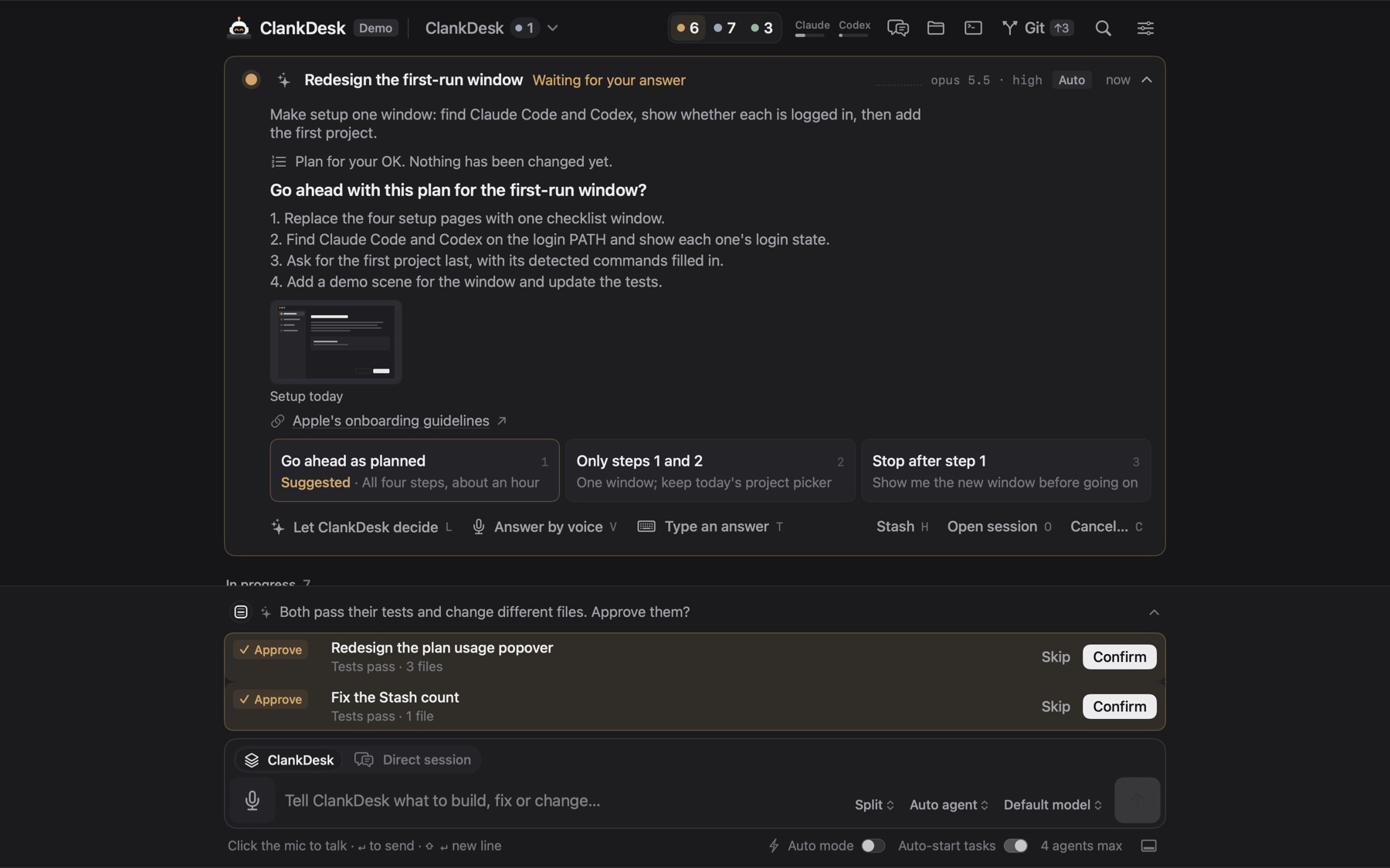
ClankDesk keeps both states on every task and derives what you see from the pair. A finished, unreviewed task becomes a review card with Approve and Reject. An approved task leaves the board. A task waiting on your answer jumps above everything else, whatever stage it was in.
Order by attention, not by workflow
So instead of columns, ClankDesk has one list ordered by who needs to act:
- Needs your input. Questions with their options and a recommendation, permission prompts, failures that ran out of retries. These always sit on top.
- In progress. One quiet line per task saying what the agent is doing right now.
- Ready for review. Finished work with its summary, images and diff, waiting for your Approve.
- Backlog, stashed and done, folded away until you want them.
Cards pop in when you speak, rise to the top when they need you, and get out of the way once reviewed. The header counts say the rest: how many need you, how many are working, how many wait for review.
Side by side
| Kanban board | ClankDesk | |
|---|---|---|
| Who moves cards | People, by dragging | Nobody. State comes from the agents and your decisions |
| Layout | Columns by workflow stage | One list ordered by attention |
| States per card | One (the column) | Two: execution and review |
| How work arrives | You create cards | You talk or type; ClankDesk splits it into tasks |
| Finished work | Piles up in Done | Leaves the board once approved and merged |
| Best for | Teams of people coordinating | One person directing many agents |
"But I like seeing everything at once"
Fair. The point of ordering by attention isn't to hide work, it's to stop making you search for the part that matters. Everything is still one glance away:
- The header counts what needs you, what's working and what's ready for review, across every project.
- Every card carries a one-line summary of where it stands. The Detail setting (Less, Medium, More) decides how much each card says.
- Backlog, stashed and completed work fold into their own sections, a click away.
- Search in the header finds any open task, and recently finished ones.
The difference is the default. A Kanban board shows you everything and lets you find what matters. ClankDesk shows you what matters and lets you find everything.
When a Kanban board is the right call
To be fair to Kanban: if your agents work alongside a team of people, and the board is where that team already lives, a board that agents can update is a good idea. Shared visibility matters more there than one person's attention. If your work is planned weeks ahead in tickets, columns map onto that well.
ClankDesk is built for a different moment: one developer, a handful of agents, and a stream of things to build today. There, the question is never "what column is this in?" It's "what needs me?"
Not an IDE. Not a Kanban. Not a chat with a task list attached. Read the rest of the reasoning in our philosophy.
The fastest way to feel the difference is to watch it. The interactive demo runs in your browser, no download needed. The full list of what the board does is on the features page.